GLADE
2023 >>> 2024
Uncover the secrets of a small woodland home.

Platform
Windows PC
Game Engine
Unity
C#
Tools Used
Aseprite
Audacity
Team Size
1
Team Role
Solo Developer

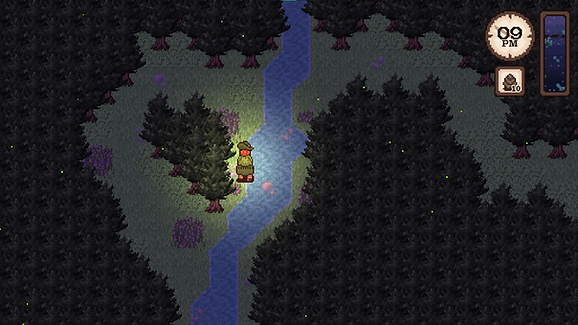
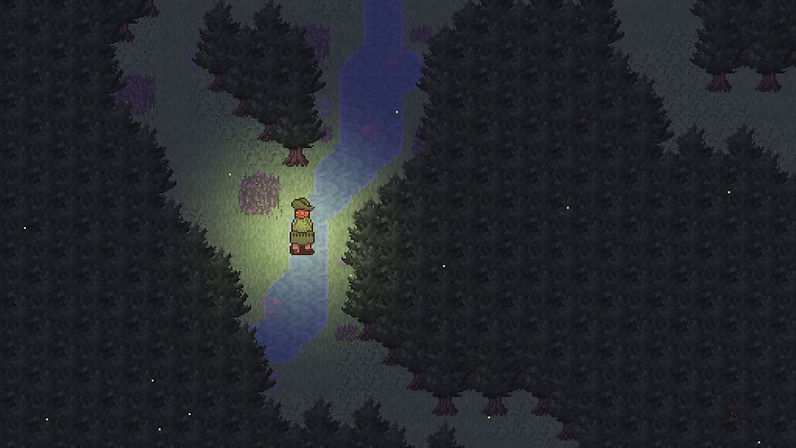
Glade is a top-down adventure game about discovering a small woodland clearing, and all of the secrets hidden within. You play as a traveller who stumbles into the glade whilst on a longer journey of their own.
This game demo was developed as a third-year university project, and functions as a glimpse into a potential wider game. It is primarily concerned with capturing the core player experience that a wider Glade game would hope to embody, evoking a sense of curiosity and respite.

PROJECT HIGHLIGHTS
Safety In The Woods
There is nothing overtly hazardous in Glade, with the focus instead being on environmental puzzles and developing a sense of safety. Mechanics such as pinecone throwing and passing time with the lute are intended to make the player feel closer to the world around them, rather than alienated by it.
+ Design
16-Bit Goodness
The 16-bit pixel art in Glade was inspired by games like Secret of Mana and The Legend of Zelda: A Link to the Past. Pixel art gives the game a retro feel that is meant to emphasise the game's nostalgic tone.
+ Art
An Eye For Polish
Glade contains lots of small touches to help build the atmosphere and the woodland, such as light filtering through the roof of the lodge, or fireflies speeding up when passing time with the lute. Focusing on polish proved to be a great way to improve the moment-to-moment experience of being in the glade.
+ Design
+ Programming


I shared the prototype with my team at This Way Up, and it ultimately led to Tabula being the next game we would develop as a studio.

After making a couple dozen puzzles for the game and playtesting them, I produced a simple design document that explores my design process and some considerations I take when working on a puzzle for Tabula.

One way I did this was by laying out windows in a level to make a picture, such as a face or recognisable scene. It's a fun and simple way to add a little surprise and cohesion to each level, even without direct control over its pace.
I shared the prototype with my team at This Way Up, and it ultimately led to Tabula being the next game we would develop as a studio.
After making a couple dozen puzzles for the game and playtesting them, I produced a simple design document that explores my design process and some considerations I take when working on a puzzle for Tabula.
One way I did this was by laying out windows in a level to make a picture, such as a face or recognisable scene. It's a fun and simple way to add a little surprise and cohesion to each level, even without direct control over its pace.
I shared the prototype with my team at This Way Up, and it ultimately led to Tabula being the next game we would develop as a studio.
After making a couple dozen puzzles for the game and playtesting them, I produced a simple design document that explores my design process and some considerations I take when working on a puzzle for Tabula.
One way I did this was by laying out windows in a level to make a picture, such as a face or recognisable scene. It's a fun and simple way to add a little surprise and cohesion to each level, even without direct control over its pace.
I shared the prototype with my team at This Way Up, and it ultimately led to Tabula being the next game we would develop as a studio.
After making a couple dozen puzzles for the game and playtesting them, I produced a simple design document that explores my design process and some considerations I take when working on a puzzle for Tabula.
One way I did this was by laying out windows in a level to make a picture, such as a face or recognisable scene. It's a fun and simple way to add a little surprise and cohesion to each level, even without direct control over its pace.
I shared the prototype with my team at This Way Up, and it ultimately led to Tabula being the next game we would develop as a studio.
After making a couple dozen puzzles for the game and playtesting them, I produced a simple design document that explores my design process and some considerations I take when working on a puzzle for Tabula.
One way I did this was by laying out windows in a level to make a picture, such as a face or recognisable scene. It's a fun and simple way to add a little surprise and cohesion to each level, even without direct control over its pace.
I shared the prototype with my team at This Way Up, and it ultimately led to Tabula being the next game we would develop as a studio.
After making a couple dozen puzzles for the game and playtesting them, I produced a simple design document that explores my design process and some considerations I take when working on a puzzle for Tabula.
One way I did this was by laying out windows in a level to make a picture, such as a face or recognisable scene. It's a fun and simple way to add a little surprise and cohesion to each level, even without direct control over its pace.
I shared the prototype with my team at This Way Up, and it ultimately led to Tabula being the next game we would develop as a studio.
After making a couple dozen puzzles for the game and playtesting them, I produced a simple design document that explores my design process and some considerations I take when working on a puzzle for Tabula.
One way I did this was by laying out windows in a level to make a picture, such as a face or recognisable scene. It's a fun and simple way to add a little surprise and cohesion to each level, even without direct control over its pace.
I shared the prototype with my team at This Way Up, and it ultimately led to Tabula being the next game we would develop as a studio.
After making a couple dozen puzzles for the game and playtesting them, I produced a simple design document that explores my design process and some considerations I take when working on a puzzle for Tabula.
One way I did this was by laying out windows in a level to make a picture, such as a face or recognisable scene. It's a fun and simple way to add a little surprise and cohesion to each level, even without direct control over its pace.